Having a large family with more than five children seems to be an anomaly in Singapore.
My peers argue they cannot afford even to have one because childcare facilities and enrichment activities are expensive. Besides, the Government is not giving enough subsidies, tax relief and other incentives, they say.
One is adamant that she will bring up only one child and added, nonchalantly, that if she is caught with a second one, an abortion – a simple procedure, she thinks – will solve the problem.
Another friend advocates passionately against bringing a child into the world as it is an evil place.
It is difficult to convince people convinced of such arguments to have children, and it will be a Herculean task for any Government to try to persuade them otherwise. Providing more fiscal incentives will only be a futile effort.
But put a cute, cuddling, cooing baby into the arms of the most reluctant, anti-baby, anti-family person, and a subtle yet perceivable transformation happens to that person.
Often, a baby brings out one's caring instincts. The baby is so completely helpless that he will motivate you to take care of him. Soon, you begin to wonder if you too can have a baby to look after.
Once this biological maternal or paternal instinct is discovered and awakened, all the logical and rational objections to having a baby will soon be forgotten.
Skeptics will argue that this is a simplistic view and they will proclaim that they are immune to this malady.
They may be unwilling to admit this, but a baby in their arms will make them more human and more alive.
So for 2007, I would like to see more mothers offer their babies to be carried by their family, relatives and friends. Better still, offer them an opportunity to babysit your child while you take a well-deserved break.
Who knows – this temporary attachment might give birth to a desire for a baby of their own.
This article first appeared in TODAY on 3rd January 2007
Wednesday, January 3, 2007


Monday, December 18, 2006
Getting ready for that final trip
As the year-end nears and people are reflecting on rebirth and renewal, my thoughts have turned to death, instead.
A distant relative, who makes a regular trip to Singapore every four or five years to visit the friends and relatives she left behind when she migrated to England, revealed that she had begun to make her own funeral preparations. She was already 77, she explained.
She had settled her affairs with regard to her house and left instructions on what to do should she go into a coma. And, on this last trip, she made her peace with everyone she met.
After my father died, my mother immediately went to see a lawyer to make a will. Bolstered by her faith, she appears to approach death without trepidation.
I also spoke to a woman who had cancer of the womb and who was not yet ready to face death. She had her womb taken out last year. Although her religion, too, assures her a place in the afterlife, I sense she is not so eager to move on. Despite this, she, too, has made detailed plans for her final exit.
As Singapore prepares for an ageing population, many of us have to face the fact that our mortality may not be that far off.
Last year, in the space of six months, two acquaintances of mine died in their sleep, leaving behind grieving mothers aged over 70 to look into their affairs.
Indeed, six reported sudden deaths in the last two months — including five healthy young people who died in their sleep — may have led some to wonder if they might be next.
Not many people would prepare for their final exit with the same attention given to their wedding. Indeed, most readily expend time, effort and money in the latter.
Yet, death is an inevitable conclusion for all of us. Most people, however, act like frail actors beyond their prime, hogging life and thinking they will be that one unique individual who will not grow old, and who can escape death.
It does not help that society does not appreciate ageing — judging from the number of anti-ageing paraphernalia advertised. A relative of mine is being pressured to dye his hair black, as it is thought no one will hire an old man with white hair as a security guard.
We are all afraid to die. Part of the fear comes from the fear of the unknown.
We wonder where we will go. Will we have to suffer for our transgressions? How do we know we won't feel pain at being cremated? And who will look after our loved ones?
As a child, a visit to the Ten Courts of Hell exhibit in Haw Par Villa instilled in me a terror of death. Now that I am an adult, I've recently started thinking that I want to face death squarely.
If I love my family, I must ensure that my death does not add to their misery of losing me.
So, I have come up with a to-do list that I must complete before the year ends.
Firstly, I will check the nomination made to my Central Provident Fund and ensure that all my six children will have an equal share of my funds.
Secondly, I will cancel all my credit lines and credit cards. This is because of a discovery that if I were to die suddenly, my next of kin would inherit my debts.
Thirdly, I will make an Advance Medical Directive. It might not be the same one provided by the Ministry of Health but I will let my next of kin know how far to go to keep me alive.
Finally, I will plan my funeral like a bride plans for her wedding. I will decide on the songs, the kind of service to have and how long the wake will be.
Some people may feel it is unlucky to think about death and that it might hasten the unwelcome event. But not caring enough to prepare for one's death might just be one of the most selfish, unloving acts towards our loved ones.
This article first appeared in Today on 18.12.2006.
P.S. I have left instructions that the picture found in this blog profile be used as my lorry photo. For those who are coming for my wake, have fun, spread happy thoughts. Be Good, Be Happy. Be Gone.
Of course there will be a Toastmaster meeting at my wake with table topics and prepared speeches. The great philospher should return the favour and present a eulogy for me just as I have done for him at the NUSA Toastmaster meeting long time ago.
Please treat this as a personal invitation. We will need a L.E. G.E T.M.E and T.T.M, Timer and Ah Counter.
My students will remember that when asked when to hand up their work I often say "Before I die."
Thursday, December 14, 2006
This season, spread only good cheer
Unlike Hong Kong, we have become too lax with our habits, post-Sars
HEALTH Minister Khaw Boon Wan's comments on Sunday ("March in step to stop disease outbreak", Dec 11) — coming on the heels of my visit to Hong Kong — made me wonder if Singaporeans have forgotten the lessons of the Sars crisis.
Mr Khaw, speaking at the opening of the annual Keystone symposia, urged governments and individuals to regain the "spirit of decisiveness and openness" they displayed during the 2003 Sars outbreak, and which they appear to have lost.
On my recent trip to Hong Kong, I was with a group of people who walked around in public wearing masks. I could only infer that they had the flu and did not want to spread the bug.
At the train stations, I heard public announcements reminding those with the flu to wear masks.
I also saw a sign that read "automatic sterilisation of hands" over a device at the hostel where I was staying. And at Hong Kong airport and the immigrant centre in Shenzhen, visitors were screened for fever.
Based on such anecdotal encounters, I cannot help but feel that people in Hong Kong have taken the lessons from the Sars epidemic far more seriously than Singaporeans have.
Here, since the Sars episode three years ago, I have encountered only one colleague who wore a mask when she had a flu.
I, for one, have been guilty of not bothering to use a mask out of self-consciousness — I am afraid of the stares I will get if I did so.
I have also given up the habit of sterilising my hands properly due to laziness. I try to justify this omission by telling myself that if sterilising facilities were provided, I would use them.
The Sars outbreak caught us by surprise and it took us some time to establish good habits and a protocol to break the chain of transmission.
With hindsight and forewarning of the potential deadliness of the avian flu, our Government has been taking proactive steps to prepare for a potential pandemic.
Contingency plans are in place, Tamiflu has been stockpiled and regular checks are conducted on wild birds. But this might not be sufficient if we do not all go back to the good habits adapted during the Sars epidemic.
It boils down to taking personal responsibility to protect the community when we are ill.
It means covering our mouth and nose with tissue when coughing or sneezing, and not spitting in public (which is a finable offence in any case).
Most important of all, we should wash our hands with soap and warm water after going to the toilet or handling live birds, raw poultry and uncooked eggs.
Three years ago, medical experts warned that there was no room for complacency when dealing with Sars and other infectious diseases.
This Christmas, as we gather for celebrations, let us remember to spread only good cheer — and not the flu virus.
This article first appeared in TODAY on 14.12.2006
Saturday, December 2, 2006
Reflection at Hong Kong Day 4 and 5
I am now back in Singapore safe and sound having slept the whole of Saturday recovering from living in Hong Kong.
Day 4 saw me going to Shenzhen but did not survived for three hours and I decided to leave. I did not like the place at all and felt very lonely. The sales ladies were very good as they managed to make me buy a lot of stuff without realising that I do not need them.
I suddenly felt so home sick that I tried to convince the airline office to let me change my flight but I could not. I went to several hotels but they were all overbooked. I could not stay at the Institute hostel as it was the last day of the conference and I had to check out.
I found a hotel that is like Hotel 81 type. I stayed there for two hours to rest my legs and then went out for dinner. I looked at a night market but could not buy any stuff as I did not have much money left.
Next day, I woke up at 5 a.m.and waited for 6 a.m.before I explored Hong Kong. I have travlled on all the MRT lines and found a little town with a lot of governmnet flats.
Next, I went to Lantou Island to see the Big Buddah. I loved that place as there are many good relief where my students would have found it useful for map reading.
I went back to Taipo to get my luggages and presented a bunch of roses for Coco Ng who was kind enough to let me keep my bag at the Institute.
Also said Goodbye to the nice sales ladies who sold me 3 pair of boots. The Tim-sum ladies actually thanked me for selecting her tim-sum. The taxi driver waited for me at no extra charge when I wen to collect my luggage.
Last minute, I was mad enough to buy six botttles of conditioners and shampoo for my Ess and daughters only to find out that I cannot checked in as hand luggage. I was already 10 kg over weight (The baggage not me. Me I am 30 kg overweight) and this added to more weight.Sight.
Although I learnt alot from the conference, I felt very lonely and did not enjoy touring and exploring Hong Kong on my own.
Thursday, November 30, 2006
LET THE CHILD OFF, AND DAMN HIM
WHEN I share with friends that we believe in caning our children, we are often met with disbelief and sometimes horror. Some would even suggest that we are barbarians.
Once, our six year old persisted in lying despite numerous efforts to explain to her the importance of telling the truth. She was caught red-handed this time and we decided to cane her.
Her grandmother became her greatest advocate; I guess she did not wish for us to inflict pain on her grandchild. But had we given in to grandma's pleas, our daughter would have learnt that she can escape the consequences of her actions.
Worse, she would have learnt that as long as an action can be rationalised away, she need not be caned.
We have a standard operating procedure for the caning session. First, the child is asked to go to the toilet to relieve herself. Then, she is required to bring the chair to us — this is the chair she bends over to present her backside for caning.
Next, she chooses the cane (normally it's the simple one). Notice that we have built up the tension for the session, so much that a light touch of the cane would bring on the maximum impact.
Of course, sometimes when the crime is very serious, we will not spare the rod and we give three or more hard thwacks on the backside that will leave red marks for a few hours, even days.
Does it work? Yes, as the fear of punishment or the memory of the caning session has made our children toe the line. Our friends are impressed that our six children are so obedient that our orders (especially their father's) are obeyed.
In our family, the father is the highest authority. Unlike the stern father figure that most of us have grown up with, my husband plays and laughs with the children. Yet they know that if they cross the line, they will get it from him.
Some fathers are afraid of appearing authoritative or aloof to their children. They try to be a "good buddy" or a good-time Joe to their children at all times.
By making life exclusively a game, they show not only that life is not serious but that authority is frivolous. Believing that he is doing good for his children, such a father instead creates a vacuum of authority in their mind.
Many teenagers, too, rebel against the discipline of the home. French author Henri Delassus warned against this phenomena in the early 20th century. He argued that a great mistake has been to ignore the traditional emphasis on the role of authority a husband and father should exercise.
I am not suggesting that the father should be an autocrat, where his home is his castle, his word is law and his wife and children tip-toe around his wishes. But by being authoritative, the father provides the boundaries for the child to grow up in a secure environment. The child knows that he can be free to grow and explore as long as he stays within the limits.
And if the child should cross the line, punishment must be immediate and painful. Too often, parents are afraid to allow their children to feel pain and deprivation. Instead, they explain away the children's wrongdoing, saying that he or she is still young, still growing.
The first concept my baby learns is the word: "No". As he crawls around the house, we say "no" if he touches the plug or other out-of-bounds items. If he insists, we hit him lightly on the hand and he soon learns that certain things cannot be done.
Of course, sometimes he cries and throws a tantrum, and we are tempted to give in. If we do so continuously, then he will grow up a spoilt brat. But if we ride out the crying storm, we teach him that blackmailing us is an ineffective way to get our attention.
Disciplining a child cannot be outsourced to the school. If a child is well brought up at home, he will learn to function well in school and there is no need for the school to discipline the child.
When a child does misbehave in class, the parent must support the school in applying punishment in accordance with its rules.
The greatest disservice any parent can do is to override the schools' authority — if the child gets away scot-free, he grows up leaning that he can break the rules of society.
"There is nothing to fear as my papa will bail me out," he thinks. That is, indeed, a fearful thought.
This article first appeared in TODAY on 30.11.2006
Reflection at Hong Kong Day 3
Today, I realised why so mnay studnets in Singapore found it difficult to understand physical geography and especially map reading. This is because Singapore's relief is flat with a small hill of about 100m at Bukit Timah.
Here in Hong Kong, it is surrounded by hills. That is what Kowloon means. Nine Dragrons refering to the nine hills arounding Hong Kong Island. I managed to take sometime off to see the PEAK. A tourist attraction where I can see the whole of Hong Kong but the view was not clear. Could be due to the haze or the mist. I also saw alot of ridges and vellys and inter-locking spur.
When I attended the conference dinner, I met a very progressive educator all the way from ..... Singapore. She was the main driver for the homeroom system and explianed to me why it was successful in her school.
In the mornig, I could not sleep and wrote an article about caning. Glad that it was published and I have posted it.(To my children you know what to do with the black file right? Bel I am refereing to you)
I brought three pairs of boots one for myself and two for my daughters. I must thanked them for helping to transfer money into my account so that I can survive in Hong Kong. After tomorrow conference ends, I will go to Shenzhen to look see look see.
Of course you can expect me to use what I have seen in Social Studies.
Attending this conference has allowed me to see how different countries trained teachers, how education has changed over time. A keynote addressed that impressed me was given by Jane Gilbert from New Zealand. She gave reasons why ITC is not working in many school all over the world. This is because knowledge is still seen as a noun something to rememeber, use it in the exam and then throw it away. She proposed that we see it as a verb . Think about that !!! What does it means? Powerful ? Right?
I will not have internet access until I come back to Singapore . So have a great day
Wednesday, November 29, 2006
Reflection at Hong Kong Day 2
It was an enriching experience meeting so many people in Hong Kong.
I did not know that Mayflower have such a good reputation that people here also said that it is a good school.
I presented my paper. Got many ideas on how I should go on imporving the way I am teaching in class and also how to imporve my research method. To do so I need about fifty of my students from Mayflower and Serangoon Sec to complete a survey form. If you all are interested please tell me and I will start on this project. I will email the survey form to you all.
Remember I taught you all about the ridge? Well I am living high up near a ridge which means I am surrounded by mountain.
After the conference, I went exploring and ended up in Hong kong Island. But the day ended so fast that by 6 p.m. it looked like ten p.m.in Singapore. It was pitch dark.
Also in this institute, the students are protesting about something. They have banner all over the campus protesting about an issue. When I can upload the picture you will be able to understand the issue.
My Cantonese suck big time.
Yesterday, at 9.30 a dragged myself wearly to a fast food resturant. Wah so much food for $8. I could not finish. There was bacon, two big piece of chicken, two pieces of beef and plenty of vegetable and fries.
I miss my family very much and am tempted to come home early but I will not.
Tuesday, November 28, 2006
Reflection At Hong Kong DAY 1
O.k. I am breaking with tradition. Normally I do not blog. I just upload my articles. But this is an exception. I am trying to blog and see the effect.
Yesterday woke up at 4 a.m. to catch a flight at 7 to Hong Kong. Slept most of the time. But Hey I managed to look at clouds from both side now.
(http://www.youtube.com/watch?v=ifyvhrfp kw&feature=PlayList&p=6E647A5F21AAC947&index=10)
Really . Saw from the top after being a Geography teacher for so long. All the convectional cells, Cumulus Clouds a field of Cumulonimbus Clouds anf of course Cirrus Clouds
Touched down at 10.30 a.m. and took me 2 whole hours and $30 (Sing) by two MRT and bus to get to the Hong Kong Institude of Education. It is sited in a mountain range surrounded by beautiful mountain. Unfortunately I could not down load my pic as i do not have the programme. And yes, there are spur, steep sided slope etc for those who still remember all the map reading stuff i have taught you.
So funny. My roommate took the same plane and went through the same journey like me and we only met in the room. She is a China born researcher at CRPP.
Explored Hong Kong by myself. Shopped at Girl Street. Went mad. Did not shopped for soooooo long what with making babies, teaching O level to students who are more interested in ..... ( i will not say much. Enough)
Now I have very little money left . (Sigh)
Tried to do last minutes slides so that I do not make a fool of myself today. My session is at 2.p.m. Do not even know where it is.
I am so afraid I will make a fool of myself. What if international audience asked me so many questions and I do not have the answers? I cannot remember a single thing I want to share with them. I have forgotten all my observations. Sigh.
I am so thankfull to all of you who have taken the time to give me feedback. It will help.
Here to Life. Life is Good. I am having fun. To night will try to go to the Peak. Tomorrow after the conference may be go to Macau to try Lady Luck. ha ha. but no I only have enough to take the expensive transport back.
Listening to U-tube. Feel like I am in Singapore as I always listen to U-tube.
http://www.youtube.com/watch?v=YsqHeDtkP90&feature=PlayList&p=6E647A5F21AAC947&index=5&playnext=6
To my family:
Anicius--- hugs and kiss
Ariel--- So happy you are studying now
Atticus-- If you do not learn to read, you will not be able to understand this. Ha Ha
Amabel--- Brought sport shoes for you and some very nice T shirt. Four long sleves one. But your sister will sure to bag, borrow or steal
Aubrey --- Guest what ? You will have to bag, borrow or steal
Angus--- You cannot bag borrow or steal so I brought pents which I believe you sisters will bag, borrow or steal.
To my Ess--- Never give wife last minute box that cost $3.95 at 7-11. She do not know how to lie.
O.K. All It is 6.26 a.m. Going for breakfest, calm myself and must not feel small with all these researcher, PHD, BIG Shot speakers and Professors.
As the school have taught me. Be Mighty in Thoughts and Deeds, no matter how small i feel.
Saturday, November 25, 2006
Teach Less, Lead More.
Paper presented for tne APERA conference
ABSTRACT:
This workshop focuses on the quality of thinking that students can develop in class. Socratic Dialogue is used to develop thinking skills. Students are trained to think clearly by questioning assumptions, asking insightful questions and exploring alternatives. In the Socratic Dialogue, entire lessons are devoted to fielding questions from the students instead of teaching from the textbook. A safe and inclusive environment is created which encouraged students to query and debate.
Keywords: Quality of thinking, Socratic Dialogue, Thinking Skills, assumptions, explore alteranative
INTRODUCTION
I experimented with my classroom teaching method by using the Socratic Dialogue with a class of social studies students. This experiment was inspired by my participation in Singapore’s one and only Philosophy Café, started by a professional philosopher, Mr. Lau Kwong Fook.
In addition, I was not satisfied with just content teaching. It was difficult to engage my students if I used the traditional talk and chalk method. Moreover, quality thinking seldom took place. Thus, I saw the need to change my teaching style so as to engage students in critical thinking.
Like many teachers, I used to focus on covering the syllabus and content at the expense of engaging students in thinking through the issue. For example, my students were able to explain factors involved in an issue without demonstrating their ability to provide comparative answers, where they can judge the relative importance of different factors in relation to an issue discussed.
I have come across two other educators using a similar method. The first was a math teacher, Rick Garlikov, who used this method -- to teach his third grade students binary arithmetic by asking them questions. He discovered that students did not get bored or lose concentration if they were actively participating in a classroom activity. However, he cautioned that this method takes a lot of energy and concentration, and that a teacher cannot do this for every topic or all day long. It demands a lot of preparation and thought.
The second was Assistant Professor Xiang Cheng from the Electrical and Computer Engineering Department of National University of Singapore (NUS). He used this method to teach control system design for guided weapons to graduate students pursuing a master degree. Like Garlikov, he discovered that the Socratic Method was one of the most effective ways to get students involved, as they had to figure out the answers by themselves. However, he warned that because of the complexity of the concepts involved, as well as time constraints, he could not implement the purest form of the Socratic Dialogue -- where only questions were used to arouse curiosity and to guide the students logically to figure out a complex subject through their own thinking. Thus he modified the method: he gave students hints when they got stuck.
My Socratic Dialogue, however, differs from both their approaches in one significant respect. Instead of me asking my students questions, I demand that my students ask the questions, either addressed to me or to each other.
DEFINITION OF PEDAGOGICAL APPROACH
Three outcomes can take place each time a teacher and students engage in class.
First, teaching occurs when most responsibility and power are laid on the shoulders of the teacher. He or she decides on the content, the pace and the quality of teaching that will take place in the classroom. Students are passive receivers of knowledge waiting patiently for the right moment (usually during the exam) to release back to the teachers what they had received.
Second, learning takes place when the focus is on the students. Teachers act as facilitators ensuring that students are engaged in their assigned activities. Normally, group interaction and exchange of information among students are paramount. Here the responsibility of learning rests on both the teachers and students. Teachers provide the worksheets, and students use them as a guide to their learning.
Third, education happens when teachers and students learn from each other. I experienced this process through the use of the Socratic Dialogue in my classroom teaching. Here power and responsibility lies in the students as they decide on the pace of the lesson and the quality of the lessons conducted. Students are given the right to lead the lesson to where they want to go depending on the quality of questions that they ask. Often they will ask me questions that I cannot answer, and that will encourage me to seek the answers and in the process I am educated.
INQUIRY-BASED EDUCATION AS THE PEDAGOGICAL PRINCIPLE
The pedagogical principle under lying the Scoratic Dialogue is based on the inquiry-based education as envisioned by John Dewey (1859 – 1952), an American philosopher, psychologist, and educational reformer.
Fundamentally, this approach is learner-centered. However, defining inquiry-based education is a challenge as it ranges from constructivism, problem-solving approaches to project-based learning. It is a multi-prong educational approach, with as many interpretations of Dewey’s version as there are teachers.
Underlying all these approaches is the learner, what he knows and what he wants to learn, and not on what can be taught. Dewey acknowledged that a learner has the instinctive desire to find things out and that he wants to communicate this discovery through conversation. He also recognised that schooling is not just about the individual but the coming together of the individual’s interest with those of society. The Socratic Dialogie is one approach where teachers can weave a child’s interest with those of society.
For learners, the Socratic Dialogue ends the listen-to-learn paradigm of the classroom and offers them an authentic opportunity to engage in learning though questioning. Through this, they make discoveries for themselves in their search for new understanding, and power is given to them as they decide on their pace of learning.
For the teachers, it ends their paradigm of talking-to-teach and recasts them in the role of a guide and mentor engaged in the same quest as the learners in class.
THE SOCRATIC DIALOGUE IN THE CLASSROOM
In the Socratic Dialogue, the stress is placed on broadening the intellect of the learner and the development of their critical thinking skills, rather than simply on the memorization of lessons. It gives the students the chance to discover thoughts, ideas and concepts for themselves. With this method, they arrive at the understanding of the concepts by themselves and the responsibility for learning lies with them.
The teacher is the catalyst directing students’ discussion rather than the bearer of all information. Open-ended questions are asked instead of closed-ended questions. The teacher talks less and allows the students to lead the discussion. A successful lesson is one where the discussion is student-dominated.
One of the desirable outcomes of this method is to observe the student see the light at the end of the tunnel. Often the student’s eyes light up when he or she figures out the solution to a problem. It is a way to refresh the student’s curiosity about the world, encourage him to be open and to take more risks and responsibilities in class.
The Socratic Dialogue is a simple process to implement. Students are forced to ask questions (failing which silence reigns) about a topic which they have been asked to read or research on. Based on the questions asked, the students will determine the quality of the lessons produced.
The difficult part is establishing this process of asking questions. Most students do not like to ask questions -- for a variety of reasons. They might not have a clue about the type of questions that need to be asked. They might feel shy and worried that their friends would laugh at them or worry that the teachers might scold them if they ask the wrong questions. The greatest obstacle is that they are seldom given an opportunity to question the teacher, as they have been conditioned in the classroom to accept everything that a teacher says.
To establish this culture of asking questions, I start the first lesson by playing a game of 20 questions. I will invite them to ask me 20 questions about anything under the sun. The questions can range from the silly ones like asking for my name, weight or height to serious ones like why are we in school. I promise the students that I will answer any question that they ask me, and I usually uphold my promise. I want to create a safe environment where students can feel secure asking questions. Once this rapport is established, it becomes easy to conduct the Socratic Dialogue with the students. Their curiosity aroused and satisfied, they will want to continue to using this method to study social studies.
IMPLEMENTATION IN THE CLASSROOM
There are two stages in conducting the Socratic Dialogue. In the first stage, students are asked to read the textbook chapter which will be discussed in the following lessons. I make the critical assumption that students will read the chapter assigned to them. Only if they do so will this method be successful.
In the second stage, where the Socratic Dialogue takes place, I will produce a stimulus for the students to consider. Usually this can be a cartoon, a text from a newspaper cutting, a picture, an extract from a website or any other relevant material related to the topic that they have read about. They are then invited to ask questions using the sources provided as a springboard. My role as teacher is to act as a resource person to answer some of the questions asked while asking some questions to encourage students to probe further. Sometimes I will redirect the questions to other students.
Although this method looks simple to implement, it demands a great deal from both the students and the teacher.
This method demands that students reflect and think independently and critically. In the process, it promotes self-confidence in one’s own thinking. At the same time, it promotes socialization skills as the class as a whole works together to search for truth in answer to a particular question. The aim of the class is to reach consensus as a way to deepen the examination of a particular issue.
Some of the questions that I have used for classroom discussion include
• Does size matter? (On the constrains that hinder the development of Singapore)
• Should Singapore aim to be a New York or a Tokyo? (On the type of development that Singapore should pursue with New York representing a creative and vibrant society, and Tokyo representing a hardworking but conformist society.)
• Is the Integrated Resort a boon or a bane?
For this method to work, I have to ensure that the discussion is grounded in the following areas.
First, the discussion must be held in the context of their experience. In this way, my students would see the relevance of pursing an issue in depth.
Second, students must work at a particular question until it is answered. They should not be satisfied with the first answer that is provided, but should test it with empirical evidence, contextual knowledge or cross reference it with other sources.
Third, students are trained to be open to the views and opinions of others, and to examine seriously both their own views and others so that everyone is working towards a consensus.
PERSONAL REFLECTIONS
Using Socratic Method in the classroom, I have discovered that given this environment students can be as engaging and serious as the academically stronger students. In addition, they have ownership of the knowledge and concepts because they have discovered it by themselves. I also observed that they have begun to ask more in-depth and probing questions. They are also motivated to read up on their own.
However, I have observed that each student develops at a different pace. The more outgoing and outspoken students would buy in to this approach while those who are shy or have less confidence in themselves tend to be satisfied to be observers.
Some students argued that they have been taught in the traditional teacher-talk method since young and found it difficult to think and to come up with questions. They also found this method unstructured and ill-defined. They’d rather rely on notes where they can exercise their memory power. They requested for notes to be given to them and they promised that they would be able to learn the notes for the examination.
The greatest challenge thus is to break the paradigm that students have about teaching, learning and education. Students still feel uncomfortable when autonomy, responsibility and power are given to them. Perhaps their creativity and curiosity have been eroded over the years in their relentless pursuit of examination grades
The second challenge that I face is to ensure that the syllabus content is covered. Often, I have made the wrong assumption that if I have taught a chapter, then learning has taken place. This is not always true.
By using the Socratic Dialogue, I have an opportunity to check on the level of understanding of my students. When several students asked me a set of similar questions surrounding one particular topic, then it is an indication that they have a problem handling this topic. I would then take time to cover this topic in detail. In this way, students would not be bored when they are forced to listen to all the topics that are found in a textbook, even those that they do not have any problem with.
PROFESSIONAL AND PERSONAL DEVELOPMENT
As a result of using the Socratic Dialogue with my students, I have come to respect them more. I have encountered many instances when I have an opportunity to learn from them. The type of questions that they asked during these sessions have educated me and forced me to examine the many assumptions that I had about them.
For example, many teachers believe that these students do not like history or social studies and feel that it is close to impossible to arouse an interest in these subjects. By using this method, I have discovered that students no longer view these subjects as far and remote but as having a bearing on their personal lives.
I have also learnt to trust these students to be responsible with their learning. Sometimes I have observed that they are disengaged or disinterested when they are attending lessons that are mainly teacher cantered and when a teacher does most of the talking. However, when it was time for social studies lesson, they are alive and eager as they are given an opportunity to be engaged, to express their feelings and opinions and to critically examine their classmate’s views and thought processes.
CONCLUSION
I am glad that I was given an opportunity to participate in a Philosophy café. It was through this experience that I brought this method of inquiry into my classroom. In this journey, I learn to respect everyone in the classroom. I have come to realise that everyone can think. Given a safe environment to explore and engage, any student can come up with interesting and original thoughts.
Wednesday, November 22, 2006
The Ess on Socratic Questioning
To all my ex-students in Catholic High, Serangoon and Mayflower,
Thanks to all the questions that you have asked in class, I am going to Hong Kong next week (Monday to Friday) for a conference.
The Asia Pacific Educational Research Association International Conference 2006
Educational Research, Policy, and Practice in an Era of Globalization:
The Asia Pacific Perspectives and Beyond
28-30 November 2006
Yes, unknown to all my classes, I have been doing a research on how well students in my class can think. Although I have my views, I would like to seek your views, your feedbacks on this method.
You know: where I do not bring textbooks to class, make you all sit in a circle, and make you all ask questions. If not, I will not say anything.
Be as honest as you can. The impacts, both positive and negative. It is all part of the learning process.
If I have the money, I would love to bring some of you all there. But being as poor as I am (sigh), I can only show them your comments. Drop it in the comment slot. I will also show them your response if there is internet access there.
(Hope there is. Then I will keep you all updated as the days go by in Hong Kong.)
If 5 people are interested in the paper that I have written for this conference, I will post it on this blog.
Thank you.
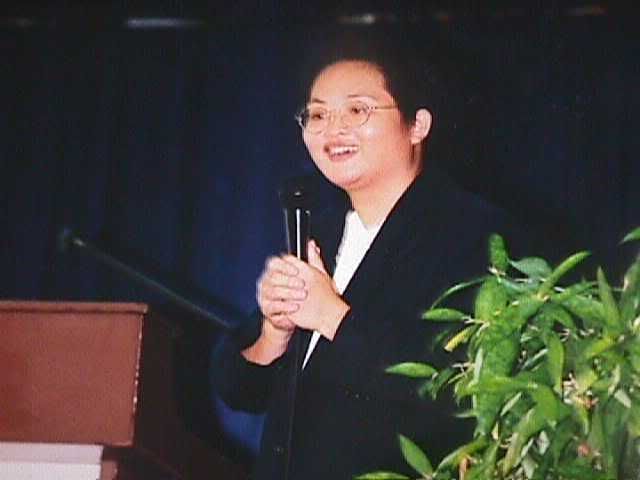
The Ess making an Ess of herself. What fun.
Subscribe to:
Posts (Atom)


